“Every soul will taste death, and you will only be given your [full] compensation on the Day of Resurrection.”
The chapter frames awareness of death as motivation for sincere, purposeful living rather than a source of despair.
Complete Life Description, Events, and Islamic History
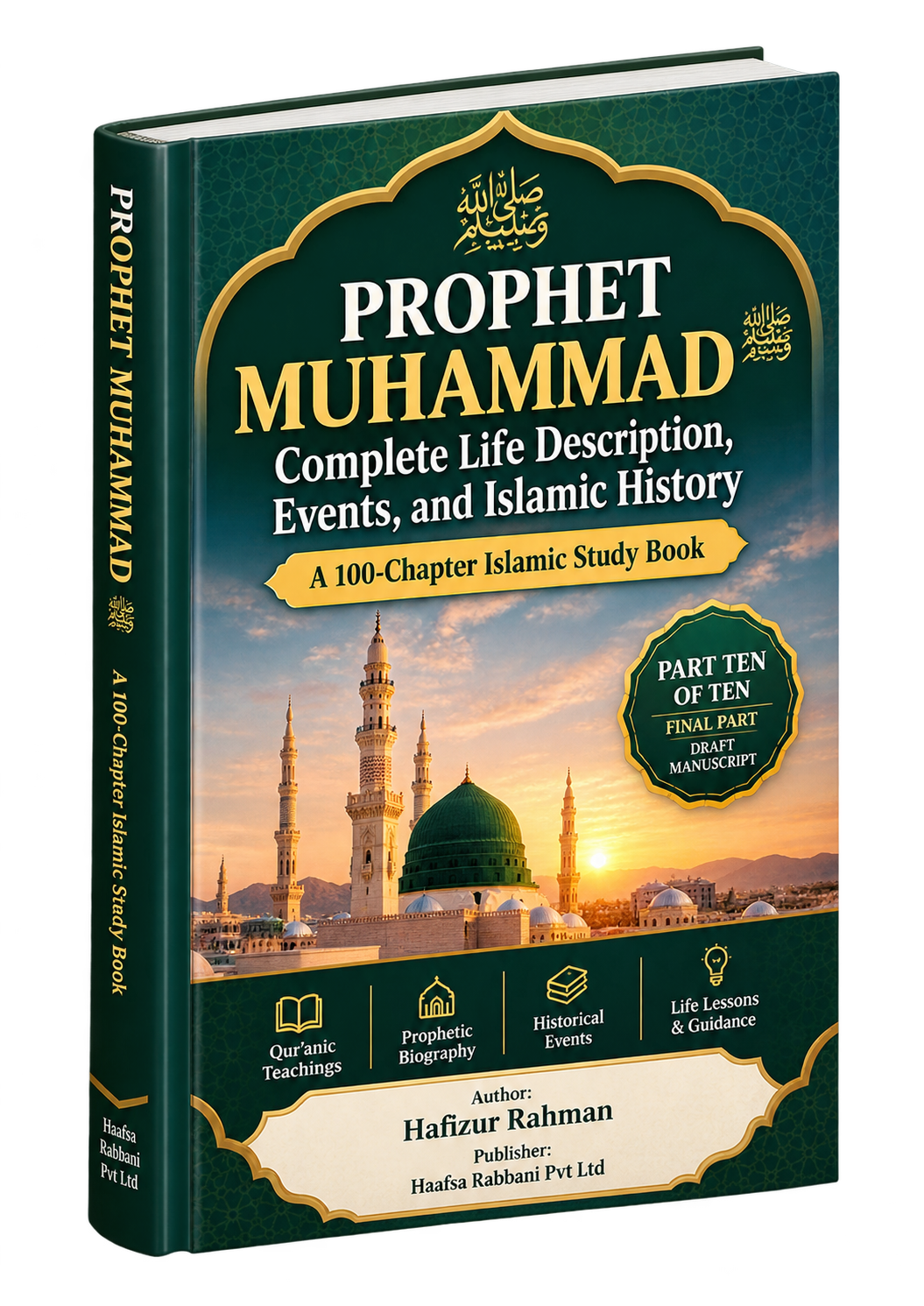
Explore the life, mission, major events, character, family, companions, Islamic history, and enduring lessons associated with Prophet Muhammad ﷺ in one structured educational eBook.
Written as an educational introduction to the Seerah, distinguishing throughout between the Qur'an, authenticated hadith, established historical tradition, and matters of ongoing scholarly discussion.
The manuscript runs to one hundred chapters across ten parts, moving from the Prophet's ﷺ ancestry and birth through the Makkan years, the Hijrah, the Madinan period, the major battles and events, his family and companions, his character, his final years and passing, the earlier prophets, the Muslim community after him, and finally the Hereafter and the lessons his life leaves behind. Every chapter follows the same shape, so the book can be read straight through or used for reference.
Each chapter presents the story, a Qur'an reference where relevant, historical context, practical examples for today, reflection questions, a chapter summary, and a source note.
Where narrations differ in authenticity or scholars differ in interpretation, the book says so rather than presenting disputed detail as settled fact.
Reflection questions and practical examples in every chapter, plus a recap of recurring lessons and a practical life checklist in the back matter.
A glossary of Islamic terms with the chapters they appear in, a timeline of major events, and a source and reference guide for further study.
Topics above are drawn from the manuscript's own chapter references, glossary and timeline. Exact chapter titles for Parts One to Nine are listed as placeholders in the chapter overview below.
Delivered as a PDF you can read on a phone, tablet, laptop or desktop.
Get this eBook →Part Ten is listed with its exact chapter titles. Parts One to Nine are shown as editable placeholders with the chapters and events the manuscript itself references, so nothing here is invented.
Replace PART_TITLE_1 … PART_TITLE_9 and each CHAPTER_TITLE with the exact headings from Parts One to Nine of the manuscript.
The book is offered as a starting point for further study rather than a final or exhaustive scholarly work, intended for educational and general informational purposes.
“Every soul will taste death, and you will only be given your [full] compensation on the Day of Resurrection.”
The chapter frames awareness of death as motivation for sincere, purposeful living rather than a source of despair.
“And behind them is a barrier (barzakh) until the Day they are resurrected.”
The book limits its treatment of this period's specific details, noting the varying authenticity and interpretation of individual narrations, and points readers to qualified scholars.
“As We began the first creation, We will repeat it. [That is] a promise binding upon Us. Indeed, We will do it.”
The chapter follows the Qur'an's own comparison between natural cycles of renewal and the ultimate re-creation.
The book notes that several pre-Hijrah dates are subject to scholarly discussion.
The author's note describes the manuscript as an educational introduction to the Seerah for general readers, students and families.
Readers who want a structured first pass through the whole life story, in order.
Chapter-by-chapter reference with source notes and a guide to fuller classical works.
Short chapters with reflection questions that work for discussion at home.
Chapter summaries and a timeline for reviewing major events quickly.
The manuscript was authored by Hafizur Rahman and published by Haafsa Rabbani Pvt Ltd as an educational introduction to the Seerah of Prophet Muhammad ﷺ for general readers, students and families.
It is a 100-chapter study book on the life of Prophet Muhammad ﷺ, covering his life, mission, major events, character, family, companions, Islamic history, and the lessons drawn from his example.
The author describes it as an educational introduction to the Seerah for general readers, students and families.
Yes. It is written as an introduction rather than an exhaustive scholarly work, with short chapters, summaries and a glossary. Readers wanting deeper study are pointed to the classical and contemporary references listed in the book.
One hundred chapters across ten parts, running chronologically from before the Prophet's ﷺ birth through to Part Ten, “The Hereafter and Lessons for Life” (chapters 93–100), followed by back matter.
Yes. Qur'anic citations are given with surah and ayah number using widely recognised English renderings. Hadith are drawn primarily from Sahih al-Bukhari and Sahih Muslim; where a specific number could not be verified against a print edition, the book cites the collection and subject matter instead.
A PDF file.
After payment is completed, the payment gateway returns you to a thank-you page with the download button for the PDF.
Yes, using any standard PDF reader on a phone, tablet, laptop or desktop.
Neither. It is an educational introduction. For matters of religious ruling and for detailed study, the book asks readers to consult qualified scholars and the primary sources it references.
Check your internet connection and try the download button again. If it still does not start, use the contact link on the thank-you page or in the footer.
One hundred chapters, arranged chronologically, with Qur'an and hadith references, chapter summaries, reflection questions, a glossary and a timeline.
You will be taken to a secure payment page. The eBook download follows immediately after payment.
This eBook is intended for educational and general informational purposes. It aims to provide a respectful, historically grounded introduction to the life of Prophet Muhammad ﷺ, distinguishing carefully between the Qur'an, authenticated hadith, established historical tradition, and matters of ongoing scholarly discussion.
It is offered as a starting point for further study, not a final or exhaustive scholarly work. Readers are encouraged to continue learning from qualified teachers and from the primary sources referenced throughout the book.